









Whatnot Clone | White Label Live Shopping Platform Development
Whatnot turned live auctions into an $8 billion business. Our white label Whatnot clone app gives you the whole machine: live streaming and real-time bidding, in-stream checkout, a complete ecommerce suite, AI features, and full user, seller and admin panels. See a complete working demo before you pay a cent. White label cost $15,500, full source code $999, 3 months free support, free deployment, optional $2,500/year maintenance, live in 15 days.
Production-grade tech, ready to scale
Clean, well-documented code in technologies trusted by enterprises.
Whatnot turned live auctions into an $8 billion business. Here is your white label Whatnot clone app.
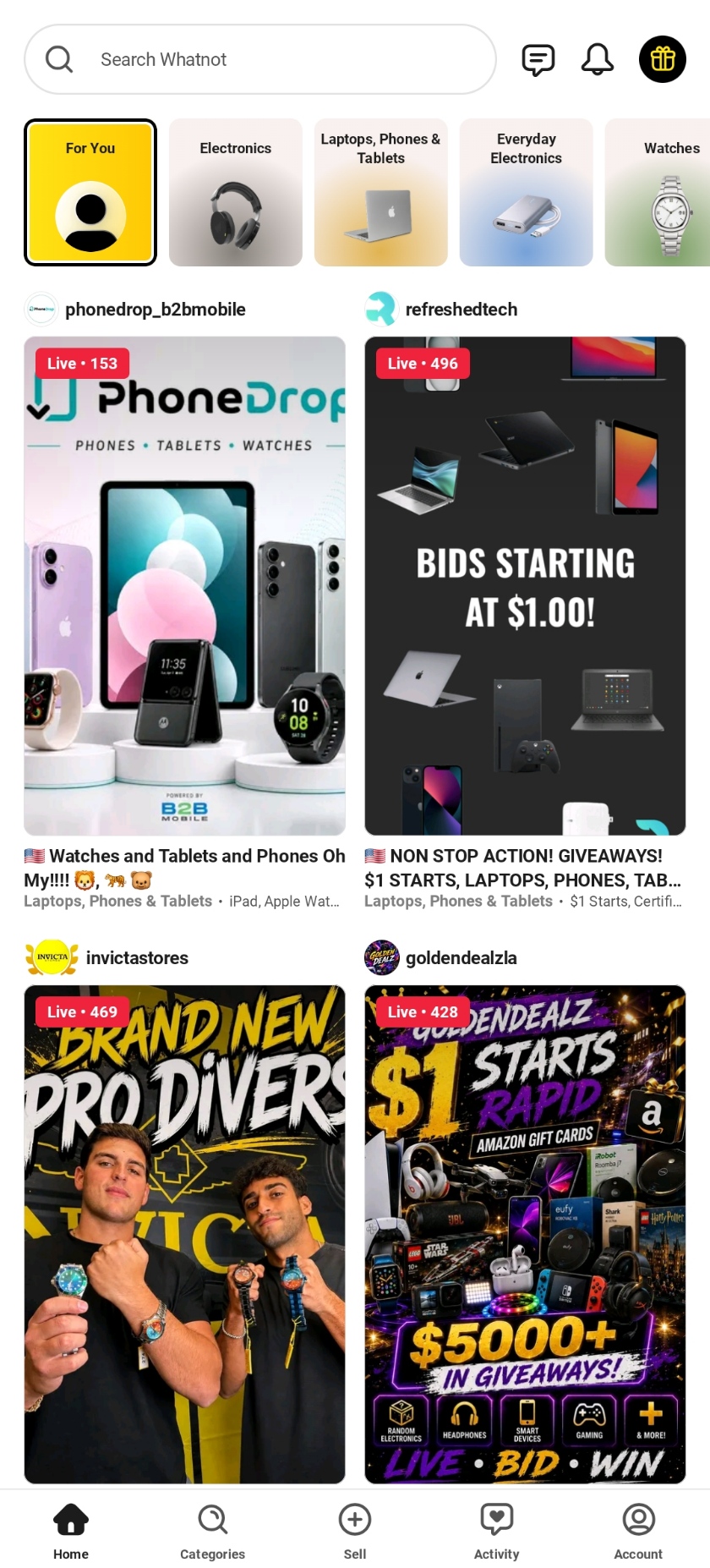
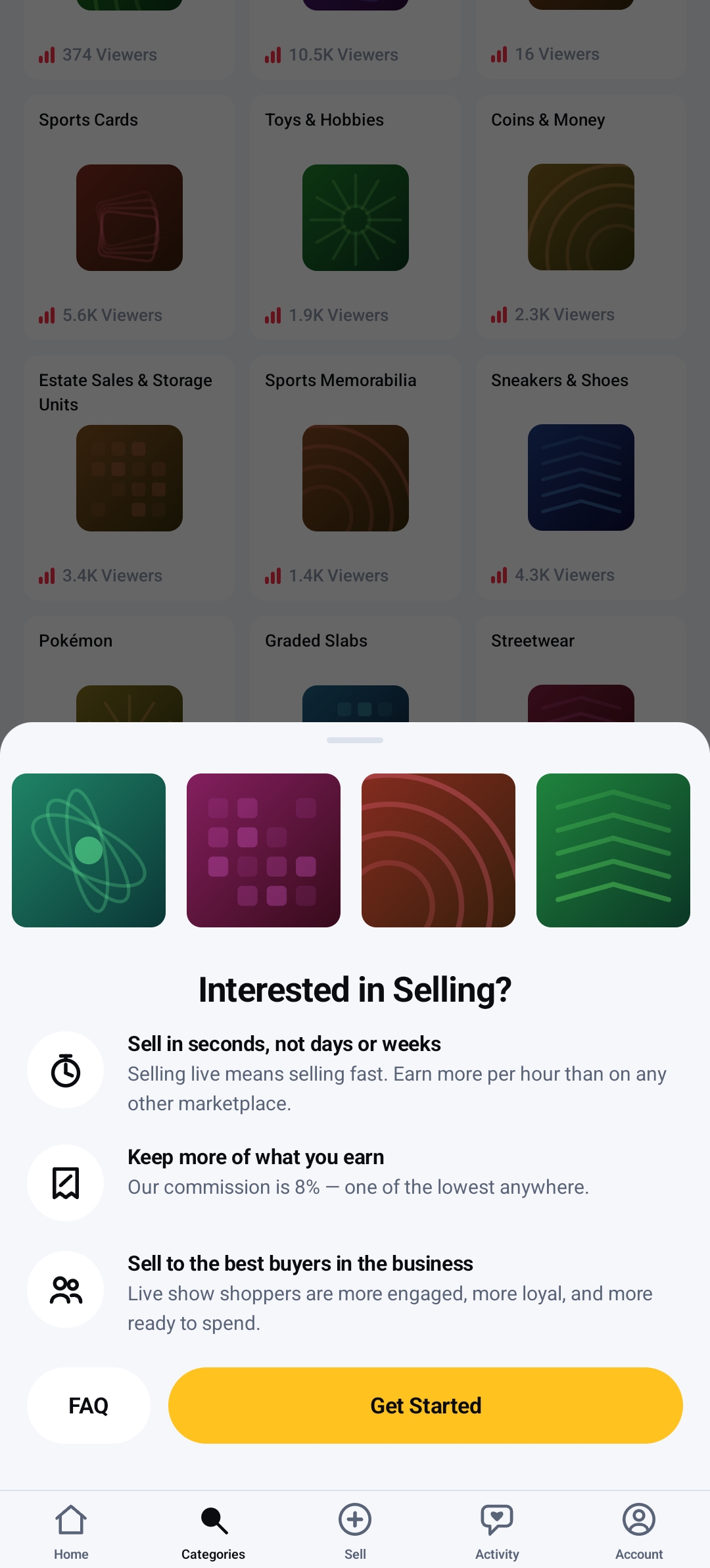
Let me be direct, because you did not come here for a lecture. Whatnot took the oldest idea in selling, a host holding up an item and taking bids, put it on a phone, and built it into one of the fastest-growing commerce companies on earth: roughly $8 billion in gross merchandise value in 2025, close to a billion in its own revenue, a valuation around $11.5 billion, and more than 250 live categories from sneakers and trading cards to beauty, comics, and coins. It earns on a simple, memorised take rate, about 8 percent plus payment processing on every sale. That is the machine, and our white label Whatnot clone app hands it to you, ready to launch under your own brand with a complete ecommerce suite built in.
Here is my promise up front, because trust is everything when you are spending real money: you see a full, working demo on a real phone before you pay a single dollar. No slides, no mockups, no "trust us". You watch a live auction run, a buyer win and check out in-stream, an order ship, and the admin light up, and only then do we talk payment. Now let me show you exactly what you get, how it works, what it costs, and why buying it from us beats every alternative.
Book your full working demo now. Watch the whole platform run live on a real device, then decide. No payment until you have seen it work.
Request Free DemoWhy invest in a Whatnot clone right now
- A market growing faster than almost anything in retail. Live commerce is compounding globally, and the West is years behind Asia, which means the runway is wide open.
- A proven, memorised revenue model. An 8 percent take rate plus processing is simple, defensible, and it scales with every show your hosts run.
- Multiple revenue streams, not one. Commission, subscriptions, featured listings, ads, buyer-protection fees, and card-break seats all stack on the same platform.
- Community moats. Niche categories build loyal buyers and sellers that a generalist marketplace can never copy.
- The fastest possible time to market. Our readymade white label Whatnot clone app launches in about 15 days instead of the many months a from-scratch build takes.
How an app like Whatnot works, step by step
- Sellers register and get verified, set up their store, and pass KYC.
- They schedule and go live from a phone or a professional OBS setup, with a go-live push notification to their followers.
- Buyers watch, chat, and react in real time, and browse pinned products during the show.
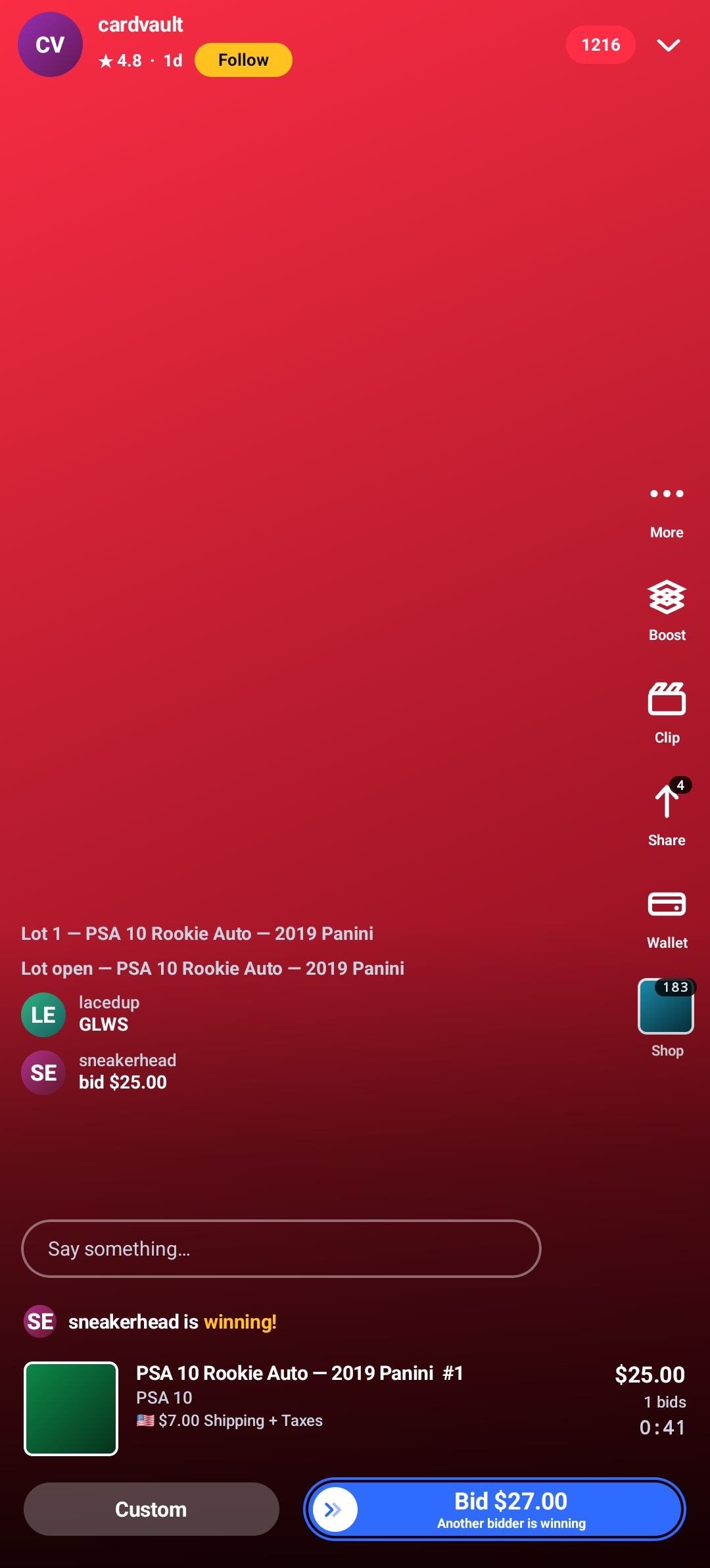
- Auctions and buy-it-now run live, with anti-snipe timers, reserves, and instant purchases.
- Winning bids check out in-stream through secure, escrow-style payment, no chasing the buyer afterward.
- Sellers buy a shipping label in-app, combine shipping for multiple wins, and the buyer gets live tracking.
- Both sides review each other, funds release on delivery, and the platform keeps its commission out of the middle.
Everything you get, by role: user app, seller studio, and admin panel
This is a genuine three-sided marketplace, native iOS and Android apps sharing one backend, so nothing is a bolt-on. Here is what each role gets.
Buyer / user app
- Sign up with email, phone, or social login, and a personalised home feed
- Live shows with real-time bidding, chat, reactions, and pinned products
- Buy-it-now and fixed-price listings, plus search, categories, and filters
- Cart with combined checkout, wishlists, watchlists, and follow-a-seller
- Secure checkout, in-app wallet and store credit, coupons, and gift cards
- Order tracking, order history, returns, reviews, and push notifications
Seller / host studio
- Seller store and profile, KYC verification, and bulk inventory upload
- Go live from phone or OBS, schedule shows, and run a live queue of lots
- Auction controls: ascending, sealed, buy-it-now, reserves, and anti-snipe
- Card breaks and group breaks, giveaways, and tipping
- Shipping label purchase, combined shipping, and order management
- Sales dashboard, per-listing analytics, payouts, and promoted-listing tools
Admin control panel
- User and seller management, verification queues, and role-based access
- Live-session monitoring, chat moderation, and report-and-block tooling
- A configurable commission and fee engine, categories, and featured placement
- Payout reconciliation, disputes, refunds, and buyer-protection management
- Ad scheduling, a content and blog manager, and marketing campaigns
- Full analytics: GMV, take rate, retention, top sellers, and conversion
The full ecommerce suite, on top of live auctions
Because your buyers should be able to shop live or on demand, the platform is a complete store, not just a broadcast. That means fixed-price listings with variants and rich media, categories, collections and smart search, product reviews and Q&A, a shopping cart with combined checkout, coupons, discount codes and flash sales, an in-app wallet, tax calculation and multi-currency, carrier-rate shipping with in-app label purchase, order tracking, returns and refunds, inventory management with low-stock alerts, a referral program, loyalty points and gift cards, and abandoned-cart recovery. Every ecommerce feature you would expect from a modern marketplace is here, working alongside the live shows.
AI-powered features that lift conversion
- Smart product recommendations and a personalised "for you" feed
- AI search and image-based product discovery
- Automated chat support and smart replies for sellers
- Fraud and risk detection on payments and accounts
- AI-assisted content moderation during live streams
- Seller analytics with demand and pricing suggestions
The tech stack, built to scale on day one
- Mobile: native iOS and Android from a React Native codebase, tuned for smooth live playback and fast checkout.
- Live video: WebRTC for the host and front-row buyers, LL-HLS fan-out for scale, on a proven media server and CDN.
- Auction engine: a real-time service over WebSockets with Redis for the bid ledger, so concurrent bids stay fair and the countdown is server-authoritative.
- Web and admin: Next.js with TypeScript and Tailwind for the admin, the seller studio, and an SEO-ready web storefront.
- Backend and ledger: Node.js on PostgreSQL, with orders, wallet, and payout ledger modelled so every cent reconciles.
- Payments and shipping: Stripe Connect for payments, escrow-style payouts, and seller onboarding, plus carrier-rate and label APIs for fulfillment.
- Infrastructure: AWS with S3 and a CDN for media, push via FCM and APNs, built to absorb prime-time show traffic.
How you make money, seven ways
You earn the way Whatnot does, and more. A configurable commission on every completed sale, a payment-processing margin, seller subscription tiers, featured-listing and promoted-placement fees, a buyer-protection fee, card-break seat fees, and sponsored placements sold against your top shows. Every rate is set in your admin, so you tune the economics to your market without touching code. On serious volume the commission line compounds fast, and the advertising and subscription lines carry the highest margins in the whole model.
Who a Whatnot clone app is for
This is the right build for individual power sellers and hosts ready for their own branded home, small and mid-sized retailers moving inventory through live shows, collectibles and card operators in trading cards, sneakers, comics, or coins, influencers and creators monetising an audience, auction houses going digital, and founders launching a live marketplace in a region or niche the giants ignore. If you have buyers to reach or sellers to onboard, the platform gives you the surface to do it.
Whatnot clone vs the alternatives: why this is the smarter buy
Look around and you will find two kinds of offer: clone shops that quote a vague range and hide the real price, and agencies that will custom-build for a fortune over many months. Here is the honest comparison.
| What matters to you | Typical clone shops | Custom build from scratch | Our Whatnot Clone |
|---|---|---|---|
| Price | Vague "$5,000 to $25,000", quote on request | $150,000 to $400,000+ | $15,500 fixed, source code $999 |
| Time to launch | 6 to 9 months | 9 to 18 months | About 15 days |
| See it before you pay | Slides and promises | Nothing to show early | Full working demo, then payment |
| Real live-auction engine | Often faked with a chat feed | You build it | Server-authoritative, anti-snipe |
| Full ecommerce suite | Partial | You build it | Included |
| Source code ownership | Extra, encrypted, or rented | Yours | Full unencrypted, $999 |
| Deployment and app-store submission | Usually extra | Your DevOps | Free, we handle it |
| Support | Vague | Your team | 3 months free, optional $2,500/yr |
Compare us to any quote you have. Then book a full demo and see the real product before you commit a cent.
Request Demo Access TodayHow we build and deliver it in about 15 days
- Demo and scope. You see the full working platform live, we map your categories, branding, and payment and shipping setup, and you get a fixed quote.
- Rebrand. Your logo, palette, app icons, splash, and domain go on in the first days.
- Integrate. We wire your payment processor, shipping accounts, and store developer accounts.
- Test on real devices. Real live shows, real bids, real in-stream checkouts, and real payouts.
- Submit and go live. We deploy under your brand and submit both apps to the App Store and Play Store.
- Support and grow. Three months of free support, with optional annual maintenance when you want it.
Why buy your Whatnot clone from Make An App Like
- We show you the product first. A full working demo before any payment. Almost nobody in this space does that, and it is the clearest proof the build is real.
- One fixed, transparent price. $15,500, plus $999 for source code, no discovery-call games and no vague ranges.
- A real live-auction engine. Server-authoritative bidding with anti-snipe and instant in-stream checkout, not a chat feed pretending to be an auction.
- The complete ecommerce suite is included, so your buyers can shop live or on demand from day one.
- You own it. Full unencrypted source code, deployed under your brand, submitted to the stores for you, with three months of free support.
- We build live commerce every week. The same team ships the Bambuser clone for one-to-one video shopping, the Bigo Live clone for social live streaming, and the DeliverIt clone for on-demand delivery, so real-time video and marketplace payments are things we do constantly, not learn on your budget.
Transparent pricing, and a full demo before you pay anything
- White-label build: $15,500 one-time. The complete platform, apps, seller studio, admin, live commerce, and full ecommerce suite, deployed under your brand, typically live in 15 days.
- Full source code: $999. Own the complete unencrypted codebase outright, yours to extend forever.
- 3 months of free support, covering bug fixes, store-rejection appeals, and SDK updates.
- Free deployment under your brand, with app-store submission handled for you.
- Optional annual maintenance: $2,500 per year, for ongoing updates, monitoring, and priority support once the free window ends.
- Full working demo before any payment. See it run, ask every hard question, and pay only when you are convinced.
$15,500 white-label build, $999 for full source code, free deployment, 3 months support, live in 15 days. Book your full demo and see it all first.
Get Exact Cost EstimationThe honest part, so you launch prepared
The software is the fast, solved piece, and we will have it live under your brand in about fifteen days. What you bring is the community and the operations: the sellers and hosts who create the shows, your own payment processor and shipping accounts, and the moderation policy you want to enforce. The winners in live commerce start focused, one strong category or region, build a loyal base of buyers and sellers, and expand from there. We give you the entire platform and the source code, and we are straight with you about the part that is yours to run, because I would rather you succeed and refer us than close a sale and disappear. You can browse everything else we build in our white-label app catalogue.
Written by the Make An App Like build team. We build live commerce, marketplace, and ecommerce platforms, and we back it with a full working demo before you pay, because the product should sell itself.
What's in the package
- Full unencrypted source code — iOS, Android, web, admin, API
- Live demo + walkthrough before purchase
- White-label setup — logo, colors, domain, app icons, splash
- Deployment on your server
- Apps submitted to App Store + Play Store under your brand
- 3 months of free updates, bug fixes & priority support
- Full technical, API & admin documentation
- Custom integrations on request
- 7-day money-back guarantee
- Tech stack: Mobile: native iOS and Android from a React Native codebase, tuned for smooth live playback and fast checkout., Live video: WebRTC for the host and front-row buyers, LL-HLS fan-out for scale, on a proven media server and CDN., Auction engine: a real-time service over WebSockets with Redis for the bid ledger, so concurrent bids stay fair and the countdown is server-authoritative., Web and admin: Next.js with TypeScript and Tailwind for the admin, the seller studio, and an SEO-ready web storefront.
How it works
- 1
Demo call
45-minute walkthrough of admin, user app, and customisation. No pressure.
- 2
Custom quote
You get a tailored 24-hour roadmap with timeline + price for your business model.
- 3
Kickoff
Pay 30% to start. We rebrand the platform with your logo, colors, and domain.
- 4
Deployment
We install on your server, submit iOS + Android apps to the stores under your identity.
- 5
Go live
Walkthrough credentials handed over. You start onboarding sellers / users / customers.
- 6
3 months support
Bug fixes, updates, priority Slack. Most clone shops vanish — we don't.
Frequently Asked Questions
How much does a Whatnot clone app cost?
The white-label Whatnot clone app is $15,500 one-time for the complete build: native iOS and Android apps, the seller studio, the admin panel, the full live-auction engine, AI features, and the complete ecommerce suite, deployed under your brand and typically live in 15 days. Full unencrypted source code is an optional $999 add-on so you own it outright. You get 3 months of free support and free deployment, plus an optional annual maintenance plan at $2,500 per year. And you see a full working demo before you pay anything, unlike the clone shops that quote vague ranges of $5,000 to $25,000 over 6 to 9 months.
Do I really see a full demo before paying?
Yes, and we insist on it. Before any payment you get a complete, working demo on a real device: a live auction running with anti-snipe bidding, a buyer winning and checking out in-stream, an order shipping with a real label, coupons and reviews in action, and the admin reflecting it all live. You ask every question you have, and you only move to payment once you are convinced it works. It is the clearest proof that the platform is real and not a set of screenshots.
What features are included for buyers, sellers, and admins?
Buyers get a personalised feed, live shows with real-time bidding and chat, buy-it-now, search and categories, a cart with combined checkout, wishlists, wallet, coupons, gift cards, order tracking, returns, and reviews. Sellers get a store and KYC, go-live from phone or OBS, full auction controls, card breaks, giveaways, tipping, shipping labels, order management, payouts, and analytics. Admins get user and seller management, live-session monitoring and moderation, a commission and fee engine, categories, disputes, payouts, ads, a content manager, and full marketplace analytics. Plus AI features like recommendations, fraud detection, and content moderation.
Is it just live auctions, or a full ecommerce marketplace?
Both, and that is the point. On top of live auctions and in-stream checkout you get a complete ecommerce suite: fixed-price listings, categories and search, wishlists and watchlists, product reviews and Q&A, a shopping cart with combined checkout, coupons and flash sales, an in-app wallet, tax and multi-currency, carrier-rate shipping with label purchase, order tracking, returns and refunds, inventory management, a referral and loyalty program, gift cards, and abandoned-cart recovery. Buyers can shop live or on demand.
How is this better than other Whatnot clone providers?
Three ways. First, we show you a full working demo before you pay a cent, while most quote a price only after a sales call. Second, we give one fixed, transparent price of $15,500 (source code $999) instead of a vague $5,000 to $25,000 range, and we deliver in about 15 days rather than 6 to 9 months. Third, we ship a real server-authoritative live-auction engine and a complete ecommerce suite, not a chat feed dressed up as an auction. We also deploy under your brand and submit to the stores for you, with 3 months of free support.
What technology is it built on, and can it scale?
Native iOS and Android apps in React Native, a Next.js admin and seller studio, and a Node.js backend on PostgreSQL. Live video runs on WebRTC with LL-HLS fan-out for scale, the auction engine runs on WebSockets with Redis so concurrent bids stay fair, payments run on Stripe Connect with escrow-style payouts, and media sits on AWS S3 behind a CDN. It is built to handle prime-time show traffic from day one, and with the $999 source-code add-on your team can own and extend every layer.
How will my Whatnot clone make money?
The core is a configurable commission on every completed sale, like Whatnot's roughly 8 percent, set in your admin. On top you add a payment-processing margin, seller subscription tiers, featured-listing and promoted-placement fees, a buyer-protection fee, card-break seat fees, and sponsored placements against your top shows. The commission line compounds with volume, and the advertising and subscription lines carry the highest margins, so the model rewards growing both sellers and buyers.
What do I need to bring, and how fast can I launch?
We deliver the complete platform, white labelled and deployed, typically in 15 days. What you bring is the community and the operations: sellers and hosts to run shows, your own payment-processor and shipping accounts, and your moderation policy. The software runs all of it smoothly, but the sellers and operations are yours to build. We help you scope everything on the demo call, and we are honest about which parts are software and which are your go-to-market.
Launch your Whatnot-style platform this month
Full source code · White-labelled · Deployed on your server · 3 months free support