







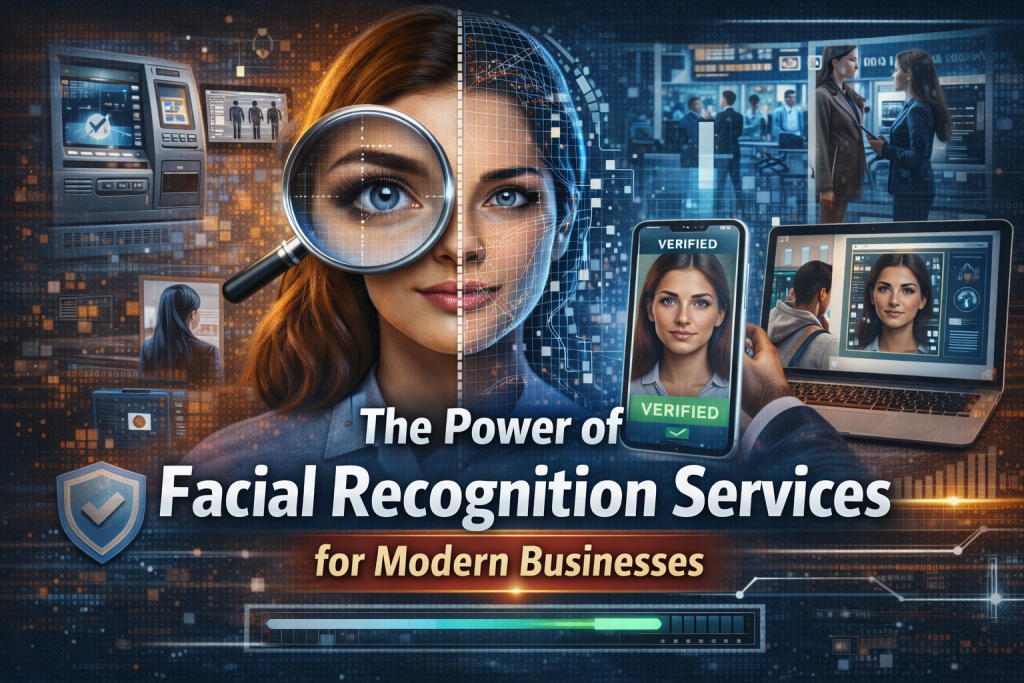
In today’s rapidly evolving digital landscape, businesses are constantly seeking ways to enhance security, improve customer experiences, and streamline operations. One technology that has emerged as a critical tool in achieving these goals is facial recognition. Once seen as a futuristic concept, facial recognition services have become practical and widely implemented across industries from banking and retail to healthcare and transportation.
This is because these services enable an organization to authenticate identities, keep track of access as well as even personalize user experiences. Using modern artificial intelligence (AI) and biometric tools, companies can recognize people within a short period and at a high precision, as well as lower the probability of fraud-related and unauthorized access-related risks. It is important to know how facial recognition services operate, the advantages of using them and how they are used together with other related technologies like the liveness detection services to remain competitive in the business.
Facial Recognition Services Knowledge
Facial recognition services denote a set of technologies and solutions that scan facial images and determine people or check their identity. These services are based on AI algorithms which map important facial features and measure distances between features and generate distinctive digital signatures of each face. When a face is taken, this can be matched to a database of existing templates to identify who it is.
There are several applications of facial recognition solutions. As an illustration, they may verify users who are accessing online sites, physical access to restricted zones or even checking who has and had come to workplaces. Facial recognition, as opposed to traditional authentication using a password or ID card, is a non-contact and smooth experience, something that has become more and more critical in the era of remote work and digital-first interactions.
The operation of Facial Recognition Services
The facial recognition services are normally conducted through several important steps:
Face Detection: This is where the system will scan a face in an image or video stream. This is where one differentiates the face and the background among other objects.
Feature Extraction: After detecting a face, the algorithms study important face features including the eyes, nose, mouth, and the jawline. Such measurements form a distinct face signature.
Creation of Templates: The system transforms the features extracted to form a digital template or facial map that serves as an identification of the person in the database.
Matching and Verification: The acquired facial template is matched with the existing templates to determine the identity or confirm the identity I am and not the person I claim to be.
Decision Making: Depending on the comparison, the system allows access, warns of possible mismatch or records the incident to analyze it further.
Liveness detection service capabilities are also integrated into a number of face recognition services. They are effective in eliminating the attempts of spoofing using images, video records, or masks since they are able to detect the presence of the face being presented in real time. Such integration boosts security especially when it comes to applications with high stakes like banking, government services, and healthcare services.
The most important advantages to contemporary business
Face recognition resolutions have a number of practical advantages to the business:
1. Enhanced Security
Developing stronger security systems is one of the main benefits of the services of facial recognition. Business can minimize the threat of unauthorized access and identity fraud through proper validation of identity of employees, customers, or visitors. Further protection to this is the liveness detection service features which make sure that only authentic persons are able to pass through authentication processes.
2. Streamlined Operations
Facial recognition solutions can also improve operational efficiency. In workplaces, for instance, automated attendance systems that rely on facial recognition can eliminate manual time-tracking, reduce errors, and save administrative costs. In retail or hospitality environments, facial recognition can accelerate check-ins, streamline customer identification, and provide smoother service experiences.
3. Individualized Customer Experiences
The current world of business has been more concerned with providing customized experiences to their customers. Facial recognition services will be used to recognize returning customers and offer personalized offers, recommendations or adjustments of services based on the past interactions. This does not only enhance customer satisfaction, but also contributes to customer loyalty and engagement.
4. Fraud Prevention and Compliance
Banks and businesses, web applications, and medical professionals have stringent control standards on identity checks. Facade recognition services with an inbuilt liveness identification check would make sure that companies are in line with the laws without engaging in fraudulent activities or identity theft. This is a combination that builds trust and secures the business and the customers.
5. Contactless and Hygienic Interactions
The COVID-19 outbreak boosted the use of contactless technologies, and facial recognition services offer an alternative to traditional authentication methods which is hygienic. Identification of the employees, customers, and visitors do not involve such touching devices and physical tokens, but make exchanges of germs lesser and the overall safety of interactions better.
Industrial Uses
The uses of facial recognition and services include a large number of industries:
Banking and Finance: To have safe access to online accounts, authentication of ATM, and avert financial crimes.
Retail and Hospitality: To optimize customer experience, loyalty program attendance, and services customization.
Healthcare: To identify patients, grant them secure access into medical records, and track the staff compliance.
Transportation: To check airport security, boarding and passenger identity.
Corporate Workplaces: To be automated in terms of attendance, access control, and security surveillance.
Using face recognition service technologies together with current systems, businesses are able to enhance accuracy, minimize cost of operation and deliver a user friendly experience.
The Role of Face Recognition Companies
The face recognition companies undertaking this will be vital in ensuring that businesses are offered with dependable solutions which are relevant to their needs. These firms design software, run databases and provide continuous services to make sure that facial recognition systems are precise, effective and do not violate the privacy laws.
A partnership with a renowned face recognition company enables organizations to use scale solutions without involving much investment in in-house development. It also guarantees the entry to the recent development of AI, machine learning, and liveness detection technologies that will keep the business ahead of the security threat and operational challenges.
Issues and Dilemmas
In spite of the great benefits of facial recognition services, businesses are also forced to overcome some obstacles:
Privacy and Data Protection: Privacy laws and regulations should be taken into account when it comes to dealing with biometric data. Organizations should also have safe storage, encryption and user consent.
Accuracy in the Demographics: It is also important to ensure that recognition systems perform accurately in individuals of various age groups, ethnicities, and faces to prevent biases and errors.
Connection with Existing Systems: The implementation of facial recognition solutions presupposes the compatibility with the existing IT infrastructure and business processes.
Security Threats: Despite the benefits of liveness detection service features in mitigating the risk of spoofing, advanced attackers can strive to circumvent the systems, and hence constant monitoring and updating are necessary.
These issues can be resolved by best practices, reliable provider selection and periodic performance and compliance audit of systems.
The Future of Facial Recognition Services
The future of facial recognition services will probably be characterized by more sophisticated algorithms of AI, the introduction of other biometrics modalities, and the further development of passive liveness detection. Frictionless user experiences, enhanced security, and operational insights are the additional ways businesses will tap into these services to enhance their business operations.
New applications can be real-time retail analytics, predictive security identification, and sophisticated fraud detection in financial services. Also, the introduction of fair and honest implementation of facial recognition services will keep shaping the industry in a way that the technology would be of benefit to both the businesses and the users.
Conclusion
Facial recognition services have revolutionized the manner in which the modern day businesses conduct security, identity checks, and customer interaction. These services offer efficiency in operations, minimize fraud and deliver customized interactions by providing correct and real-time identification. Facial recognition is made more powerful when it is combined with liveness detection services, eliminating the cases of spoofing and only verifying users.
With organizations still operating in a digital-first world, the use of face recognition solutions through established face recognition corporations should give the company a competitive edge and still be compliant and trustworthy. Knowing the technology, its uses, and best practices, businesses nowadays have the power to utilize the resources of facial recognition services and make their environments secure, effective, and convenient.

 The KYB Services Future of Digital Business Onboarding