







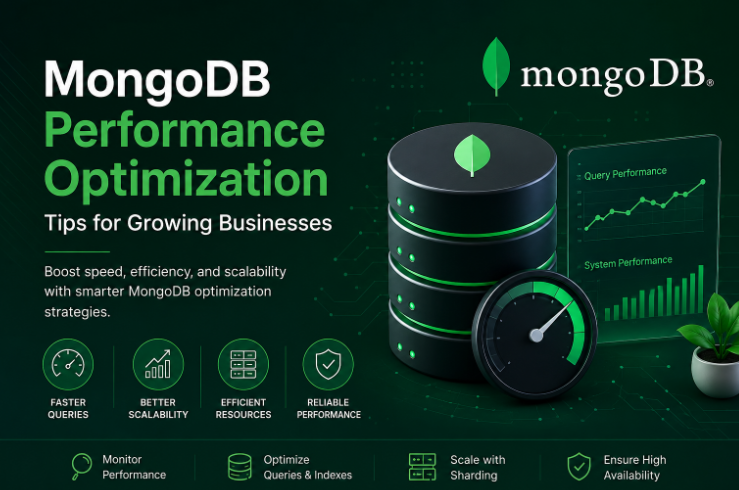
All business operators, regardless of scale, prioritize the way performance impacts how customers perceive them. Although most businesses have access to an ever-increasing amount of data processed daily by modern apps, they also need an exceptionally scalable and robust database platform capable of meeting their stringent operational requirements. Many growing businesses are choosing MongoDB because of its combination of flexibility, scalability, and capability to handle high volumes of users.
Unfortunately, a significant number of organizations do not fully optimize their use of MongoDB therefore, they experience slow query response times and increased resource consumption and, thus, performance-related issues regarding the reliability of their applications. For this reason, companies make investments in MongoDB managed services and MongoDB consulting services to ensure optimal performance levels within their respective databases.
Monitor your MongoDB Queries
Poorly executed queries are among the most common causes of slow performance with MongoDB. Organizations need to assess their queries on a regular basis using tools such as explain plans or performance monitoring dashboards because slow queries will affect an application’s response time by consuming server resources.
The following steps can be used to enhance the performance of your queries:
- Create a proper index strategy
- Avoid unnecessary data retrieval
- Optimize your aggregation pipelines
- Limit the size of any returned data sets when practicable
Indexes are an important tool when optimizing MongoDB databases. A well indexed database can dramatically decrease a query’s execution time, improving users’ experience.
Picking An Appropriate Data Model
MongoDB provides a versatile schema design, ideal for current day application design. However, if the schema is poorly planned, as the database grows, performing and scaling operations can become an issue.
When designing collections for your business applications, consider how users of your application will access your data rather than regular relational database styles. By embedding related data together, the complexity of the query will be reduced and read performance increased. Inevitably, creating large documents will increase both memory usage and processing time.
An organization can bring on professional MongoDB consulting services to assist with designing a schema that is optimised for both performance and growth.
Consistent Monitoring of Database Status
It’s important to continuously monitor your databases to catch any potential issues with your performance before they have an impact on your production environment. The best practice for growing businesses is to monitor:
- CPU Utilization
- Memory Usage
- Disk I/O
- Replication Lag
- Slow Query Performance
Being able to monitor your databases in real time gives the database administrator the ability to detect abnormal behavior quickly and respond to fix it immediately.
Businesses who use MongoDB database support services tend to also experience proactive monitoring and performance tuning which helps to minimize downtime and maintain business continuity.
Optimize the Infrastructure and Hardware
The quality of the infrastructure is directly correlated to the performance of the database. As workloads continue to grow, organizations need to ensure their servers are all set up properly to run MongoDB securely.
Consider the following criteria for good infrastructure design:
- Solid state drives improve the speed of the storage of your information
- Enough RAM is available for your working set
- Network connection is consistent
- Scale your cluster based on the increase of workload
Also, by utilizing sharding, MongoDB provides the industry with the ability to horizontally scale applications. Sharding allows for data to be distributed across several servers providing a significant increase in performance as well as supporting large applications with an ever-increasing number of users accessing them.
Routine Maintenance of Your Database
Database maintenance often gets neglected, but it is one of the most significant contributors to continued improvement in performance over time. Each organization should regularly perform the following tasks:
- Backup old data
- Eliminate any unnecessary indexes
- Check the replication health
- Update your MongoDB installation to the latest version
- Regularly review your backup protocol
The quality of your database environment will affect the health and reliability of your applications, as well as improve your operational risk management process.
Providers offering MongoDB managed services can automate much of the maintenance of a MongoDB database by providing complete end to end managed service solutions for the entire database or for specific types of databases. As a result, your MongoDB databases will be secure, optimized and continuously available.
Getting help from experienced MongoDB consultants
As companies develop their software applications, database management will be more difficult and require a broader level of expertise to handle. Some of the challenges that businesses face when it comes to managing their databases are:
- Optimizing performance
- Managing a database cluster
- Securing their database through configuration management
- Developing a scaling strategy
Working with experienced MongoDB consulting services is a very effective way for companies to avoid expensive downtime and to improve their overall productivity.
Mydbops provides MongoDB consulting services, MongoDB managed services, and MongoDB database support services to users of the MongoDB database around the world. The mission of Mydbops is to guarantee customers value from their investment in MongoDB through the delivery of consulting and technical services that support performance optimization, capacity increases, and effective oversight for mission critical databases.
Conclusion
There is a summary about how MongoDB meets the needs of enterprises by providing a scalable, flexible database that performs well at high volumes of transactions with a large number of customers by using an appropriately designed schema for the database, a properly designed infrastructure, continuous monitoring of the database and proper query optimization.
If you would like to improve the performance of your applications, reduce operational downtime, and improve the user experience by investing in a professional database optimization strategy then your organization will experience the greatest value of its use of MongoDB and therefore be prepared to continue to grow.
To learn more about how to optimize the speed and capacity of your MongoDB environment, as well as how to enhance reliability, please visit the Mydbops Official Website and contact us for expert consulting and support services for your MongoDB environment.
