







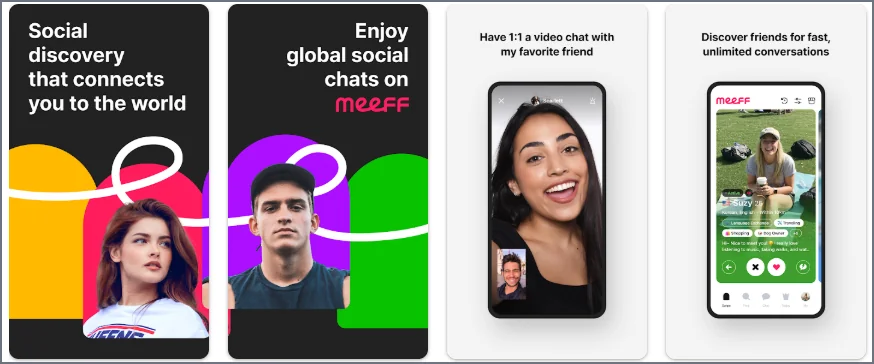
A user checks a mobile app to meet new friends. Apps like Meeff help people in South Korea connect with global friends through their smartphones.
As per my research, MEEFF is a popular social networking and dating app that helps people make global friends, especially connecting Koreans with foreigners for language exchange and friendship. It has over 10 million downloads worldwide, indicating a huge user interest in such platforms. Unlike generic dating apps, Meeff focuses on meaningful connections, cultural exchange, and language learning. In South Korea—a country with high smartphone penetration and a keen interest in language exchange—Meeff has taken the social scene by storm. It has even emerged as a convenient alternative to Tinder in the Korean market by catering to local cultural preferences.
Tinder is a global dating app, but Meeff carved a niche in Korea by focusing on cultural and language exchange, making it a strong local alternative.
Building an app like Meeff is a viable business idea for startups and investors because the demand for language-exchange dating services is growing. As per data available, online dating in South Korea is a multi-million dollar industry projected to reach $35.6 million in 2025. Meeff’s success shows that a localized approach—features tailored to Korean culture and support for multiple languages—can attract a dedicated user base. As I found over research, users value an app that lets them meet friends or partners in a comfortable, culturally aware environment rather than a one-size-fits-all dating app. In short, a “Meeff clone” (a Meeff-like app) can tap into this niche by providing a platform for genuine connections, making it a promising venture in the Korean market.
Essential Features to Include in an App Like Meeff
As per my experience in app development, the core of a Meeff clone lies in its features. You should include all essential functionalities that make the original app successful, plus any unique twists to stand out. Here are the must-have features for a Meeff alternative:
- User Profile Creation and Social Login: Allow users to create detailed profiles with photos, interests, and personal info. Social sign-up via Facebook, Google, or Kakao can simplify onboarding. Profiles should capture hobbies and language skills to enable meaningful matching.
- Matching Algorithm & Search Filters: Implement smart matching to connect people based on language preferences, location, and interests. Users should be able to search with filters (age, gender, region, etc.) to find relevant partners. A strong algorithm (possibly AI-driven) will increase the chance of compatible matches.
- Real-Time Chat (1:1 and Group Chats): Provide free messaging with instant chat once users match. Include 1:1 chats for private conversations and group chats (Meeff offers 3:3 group conversations) to make friend groups. Push notifications for new messages are essential so users stay engaged.
- Voice and Video Calling: Integrate voice calls and video calls for a richer communication experience. Meeff’s “VibeMeet” feature enables live video matching and unlimited 1:1 video calls, while “VoiceBloom” focuses on voice-only chats for language practice. Your app should have in-app video/voice call capabilities (using WebRTC or third-party SDKs) so users can talk face-to-face or voice-to-voice, bridging long-distance gaps.
- Translation and Language Exchange Tools: Since the app targets language exchange, include a built-in translation service in chats. This could be text translation or captioning to help users who speak different languages communicate easily. Perhaps incorporate fun language games or prompts to break the ice (Meeff encourages ice-breakers through games and language programs).
- Privacy and Incognito Modes: Give users control over their visibility. For example, Meeff allows hiding your profile photo initially to focus on personality. Add settings so users can appear incognito or limit who sees their profile. Privacy features build trust, especially for users wary of online platforms.
- Safety Features (Moderation & Reporting): User safety is critical. Include easy reporting and blocking tools so users can report scammers or harassment. As per data available, Meeff monitors profiles 365 days a year and swiftly removes fake or suspicious accounts. Your clone should likewise have moderation (AI filters or a review team) to maintain a secure environment. Profile verification (via phone or ID) can be added to increase trust.
- Unlimited Swipes/Matches & Premium Options: Users should be able to like/pass on suggested profiles (as in Tinder’s swipe mechanism). Provide unlimited basic matching for free to attract users. Additionally, plan some premium features (like seeing who liked you, more filters, or profile boosts) for those who opt for a paid plan. We’ll discuss monetization in detail later, but design the feature set with freemium in mind.
- Miscellaneous Nice-to-Haves: Push notifications for matches and messages, location-based discovery (show nearby users via GPS), integration with phone contacts or friend suggestions, and perhaps a newsfeed or stories for social engagement. These can enhance user engagement, but the priority is the core matching and chatting experience.
By including the above features, your Meeff clone app will offer a comprehensive platform for meeting and chatting with new friends. As per data available, Meeff provides most of these features (free chat, matching, voice/video, translation) out of the box, so users will expect the same from any credible alternative.
Recommended Tech Stack for Developing the App
Choosing the right tech stack is crucial for Meeff app development. As per my experience, a robust and scalable technology foundation will ensure your app runs smoothly even as it gains users. Here are recommendations for front-end, back-end, database, and third-party tools, based on research and industry best practices:
- Mobile App Front-End: You can develop the app natively or use cross-platform frameworks. Native development (Swift for iOS, Kotlin for Android) offers best performance and a native feel. However, many startups prefer cross-platform frameworks like React Native or Flutter to build for both Android and iOS with one codebase.
- As per my research, React Native and Flutter are excellent choices for multi-platform dating apps, as they maintain high quality and let you reuse code across devices. If you go cross-platform, ensure the UI is responsive and culturally localized (e.g., use Korean language support, proper fonts).
- Back-End Server: The back-end will handle user accounts, matching logic, chats, notifications, etc. Popular choices are Node.js with Express (JavaScript) or Python with Django/Flask. These frameworks can easily implement real-time features and matching algorithms. For instance, Node.js is known for handling concurrent connections (great for chat), while Django provides a robust structure and security. You might also consider Java (Spring Boot) or Ruby on Rails, but Node and Python are currently very common for social apps. Ensure the back-end includes RESTful or GraphQL APIs to communicate with the app, and implement secure authentication (OAuth 2.0 for social logins, JWT for sessions).
- Database: A combination of databases can optimize performance. As per my research, many social apps use a NoSQL database like MongoDB to store user profiles and preferences (flexible schema for varying profile info). MongoDB will allow quick retrieval of user data and is easy to scale horizontally. For real-time features like messaging and notifications, an in-memory data store such as Redis is recommended. Redis can handle fast reads/writes for chat messages, online status, and caching frequent queries. You may also use a relational database (MySQL/PostgreSQL) if you need complex queries or transactions (for example, for financial transactions or strict consistency), but for a Meeff clone focusing on social features, a NoSQL + Redis combo should work well.
- Real-Time Communication: To implement instant chat and live video/voice calls, choose suitable technologies. WebSockets (with Socket.io for Node.js, or Django Channels for Python) will enable real-time messaging. This ensures that messages deliver instantly without constant polling. For voice and video, integrate WebRTC – an open-source standard for real-time peer-to-peer communication. You can use libraries or services that simplify WebRTC. For example, Agora.io or Twilio SDKs can handle video call functionality if you prefer to use a third-party service for reliability. These SDKs provide built-in features for managing video streams, and they can be plugged into your app with relative ease.
- Third-Party APIs and Services: Leverage third-party tools to speed up development:
- Social Logins: Integrate OAuth APIs for Facebook, Google, or even KakaoTalk (since Kakao is widely used in Korea) so users can log in easily. This improves user conversion rates by reducing sign-up friction.
- Maps & Location: Use Google Maps API or local map services (like Kakao Map or Naver Map APIs) for location-based features. This can show nearby users or allow setting location preferences.
- Push Notifications: Implement push using Firebase Cloud Messaging (FCM) for Android and APNs for iOS, or use a unified service like Firebase for both. This is essential for notifying users of new messages or matches.
- Translation: To support multi-language chat, use a translation API such as Google Translate API or Papago API (Naver’s translation service, popular in Korea). This can be integrated server-side or client-side to offer one-tap translation of messages.
- Email & SMS Services: For verification or newsletters, services like SendGrid (email) and Twilio (SMS) can be integrated. For example, SendGrid was used to handle email notifications in one dating app project.
- Analytics: Include analytics SDKs (Google Analytics for Firebase, or Mixpanel) to track user behavior and app performance. This data is crucial for understanding how users engage with features.
- Cloud Hosting and Scalability: Deploy your back-end on a reliable cloud platform (AWS, Google Cloud, Azure, or a local Korean cloud if preferred). Use auto-scaling and load balancers to handle growing traffic. You might use AWS services like EC2 (servers), S3 (for storing user photos), and RDS or MongoDB Atlas for managed databases. Given that apps like Meeff can have millions of users, plan the infrastructure to be scalable from day one – for instance, containerize the application (Docker + Kubernetes) for easy scaling when user count increases.
As per my research, the above stack covers all bases: a strong front-end framework, a scalable back-end, and integrated services for critical functionality. For example, one team built a dating platform with Laravel (PHP) as the backend and Ionic for mobile, plus integrated Facebook/Google login, Pusher for chat, and Firebase notifications. Likewise, you can mix and match technologies that best fit your team’s expertise. The goal is to ensure your Meeff clone is fast, responsive, and capable of handling real-time interactions without hiccups.
Estimated Development Cost for a Meeff Clone in Korea
One of the biggest questions for investors is: “How much will it cost to build an app like Meeff?” The development cost can vary widely based on the scope and the team’s location. As per data available, developing a typical mobile app in South Korea may cost anywhere between ₩113 million to ₩424 million (approximately $85,000 to $320,000 USD). This range accounts for basic apps at the low end up to advanced apps with rich features at the high end. A Meeff-style social app with matchmaking, chat, and multimedia features would likely fall in the mid-to-upper part of this range if built with high quality.
To break it down further, here are some cost considerations and an estimated breakdown:
| Cost Factor | Estimated Cost (USD) | Details |
|---|---|---|
| UI/UX Design | $10,000 – $20,000 | Designing the app interface, user experience, and graphics. A polished, localized UI (including Korean and English) is crucial. |
| Front-End Development | $30,000 – $50,000 | Coding the mobile app for Android and iOS. Cost can be lower with a single cross-platform codebase, or higher if developing two separate native apps. |
| Back-End Development | $20,000 – $40,000 | Building server-side logic, database, APIs, real-time chat servers, etc. Includes implementing matching algorithms and integration of third-party services. |
| Testing & Quality Assurance | $8,000 – $15,000 | Rigorously testing the app on multiple devices, fixing bugs, and ensuring security (especially for personal data and payments). |
| Project Management & Other | $5,000 – $10,000 | Overseeing the development process, app store deployment, legal compliances, and any other overhead. |
| Total Estimated | $75,000 – $135,000 | (Approximately ₩100M – ₩180M in Korean Won) Total for developing a Meeff clone with core features. This assumes a development team in-house or local to Korea. Outsourcing to other regions might reduce some costs. |
Note: These figures are rough estimates. As per my research, a dating app with basic features for a single platform can start around $50,000+. Building a full-featured Meeff alternative on both Android and iOS with advanced functionality (video calls, AI moderation, etc.) could push the cost toward the higher end or beyond. Each additional feature (for example, an AI-based recommendation engine) or platform (like also making a web version) will add to the budget. On the other hand, using off-the-shelf solutions or clone scripts might lower costs but could limit customization.
What drives these costs? Key factors include the development team’s rates (developers in South Korea or the US typically charge more than those in some other countries), the number of features and complexity, the design sophistication, and any third-party service fees (for servers, APIs, etc.). For instance, implementing a basic chat is one cost, but implementing high-quality video calls might require additional SDK licenses or more development effort, raising the cost.
As per data available, many companies offer ready-made scripts or clone app templates for apps like Meeff, which they advertise at lower prices. These can be a starting point but usually still need customization and polishing. If aiming for a truly standout product, plan for a budget that allows thorough development, testing, and iteration. Remember, an app’s success also depends on continuous updates and marketing, so factor those costs beyond the initial development. We’ll touch on timeline next, which also correlates with cost (more development time generally means higher cost).
Development Timeline Breakdown
Developing a Meeff clone app is a significant project, and it’s wise to have a clear timeline. As I found over research, the development process typically ranges from 4 to 12 months for a dating/social app with a unique set of features. The exact timeline will depend on the complexity of features and the size of your development team. Here’s a breakdown of the development timeline into phases and their estimated durations:
| Development Phase | Estimated Duration | Key Activities |
|---|---|---|
| Planning & Research | 2–4 weeks | Conduct market research (identify user needs in Korea, analyze competitors like Meeff/Tinder). Define the feature set and technical requirements. Create a project plan and allocate resources. |
| UI/UX Design | 4–6 weeks | Design the user interface and experience. Create wireframes and interactive prototypes. Get feedback from stakeholders or potential users and iterate on the design. Ensure the app’s look-and-feel is appealing to the target audience (consider Korean cultural nuances in design). |
| Front-end & Back-end Development | 4–6 months (overlapping with design) | Develop the mobile app front-end and the back-end in parallel. Implement core features: profile creation, matching algorithm, chat functionality, etc. Set up databases and server infrastructure. This phase can be iterative – e.g., build a basic MVP (Minimum Viable Product) in 3-4 months, then refine additional features in the remaining time. Regularly integrate and test as you develop. |
| Testing & Quality Assurance | 4–8 weeks (overlapping with development) | Perform thorough testing of all features. This includes functional testing (does matching work correctly? is chat real-time?), usability testing (is the app easy to use for both Korean and international users?), performance testing (can the app handle many users at once?), and security testing. Fix any bugs or issues found. Beta testing with a small user group can be part of this phase to get real-world feedback. |
| Launch & Deployment | 1–2 weeks | Prepare for launch. This involves final polishing of the app, setting up app store listings (in Google Play and Apple App Store, with optimized descriptions and keywords in Korean and English). Also, deploy the back-end to production servers. Once ready, launch the app to the public. |
| Post-Launch Monitoring & Updates | Ongoing | After launch, monitor user feedback and app performance closely. Be ready to issue quick patches for any critical bugs discovered. Gather usage data to plan new features or improvements. Continue with marketing efforts to onboard users. This phase is continuous – a successful social app will receive regular updates. |
As per my research, a reasonably sized team can build an MVP of an app like Meeff in around 4-7 months, which aligns with the middle of the above ranges. The timeline might be shorter if using a pre-built clone script or very experienced team, or longer if you decide to add more advanced features (for example, sophisticated AI matching could extend development time). Always incorporate a buffer for unexpected delays (technology hurdles, feedback implementation, etc.).
It’s also beneficial to use agile development methodology: release in iterations. You could aim for an MVP with essential features (profiles, matching, chat) in ~4 months, then add video calls, translation, and other advanced features in updates. This allows you to enter the market early, start user acquisition, and learn from real users while continuing development.
In summary, expect about 6-9 months on average for a full-featured launch of a Meeff clone if starting from scratch, including all planning and testing. Proper planning and an agile approach can ensure you hit a timely launch without compromising on quality.
Monetization Models for Apps Like Meeff
An app may be free to download, but as a startup or investor, you need to know how it will make money. As per my research, most successful dating and friend-making apps use a freemium model – the app is free to use at a basic level, but generates revenue through premium features, in-app purchases, and ads. Here are the monetization strategies you should consider for a Meeff clone:
- Freemium with Premium Subscriptions: This is the primary revenue model for many dating apps (e.g., Tinder’s Plus/Gold, Bumble’s Premium). Users can use the core features for free, but offer a paid VIP membership that unlocks perks. For a Meeff alternative, premium features could include: seeing who viewed or liked your profile, unlimited or faster matching, advanced search filters, the ability to go incognito, or higher visibility in search results. You can offer different subscription tiers (monthly, quarterly, annual) with varying benefits. For example, Tinder offers tiers that remove ads and give a set of Super Likes/Boosts. As per data available, Tinder had about 6.7 million paying users out of 66 million total by offering such premium tiers. Your clone can adopt a similar approach: attract a large user base for free, then convert a percentage to premium.
- In-App Purchases (A la Carte Features): Besides subscriptions, provide one-time purchase options for specific features. Not everyone wants a recurring subscription, so this captures additional revenue. Examples: users can buy coins or credits to spend on sending virtual gifts, or to boost their profile for a day to appear more often to others. Another idea is selling “Super Likes” or priority messages individually (as Tinder does) for users who want to stand out. According to industry insights, in-app purchases are a great way to monetize those who won’t commit to a subscription but are willing to pay for certain perks. Design these purchases to be enticing but not mandatory for basic use.
- Advertising (Ads): Advertising can be a steady revenue stream, especially once you have a large user base. Meeff itself contains ads (as noted on its app store listing) to monetize free users. You can integrate ad banners or interstitial ads in non-intrusive places (like in between profile swipes or in a feed, if your app has one). However, be cautious: too many ads can annoy users, so balance it carefully. Many dating apps keep ads limited or remove them entirely for premium subscribers. For instance, Tinder’s free tier shows ads, but paid users get an ad-free experience. You could also explore sponsored content (e.g., a tourism ad for foreigners in Korea) or partnership promotions as part of your ad strategy.
- Partnerships and Sponsorships: Once your app has a user base, you might partner with brands or events. For a language-exchange focused app, language schools or travel companies might be interested in sponsorship. For example, organizing online events or meetups through the app (sponsored by a brand) can generate revenue. While this isn’t a primary model at launch, it can grow later. Some apps also use affiliate marketing – e.g., linking to language courses or books and earning a commission on referrals.
- Paid App or One-Time Purchase: Generally not recommended for a social app these days, as users expect free download. It’s better to keep the app free to get maximum users and then monetize in-app. So, charging upfront isn’t a popular model in this category and Meeff itself is free to download.
- Merchandise or E-commerce: This is a more novel approach – some apps (like Grindr) launched merchandise stores for their community. For a Meeff clone, this might not be relevant initially, but if you build a strong brand among young users, you could sell branded items or partner with Korean pop-culture merchandise since many foreign users interested in Korea might also be K-pop or K-drama fans. This is a supplementary model at best.
In practice, the most proven revenue drivers will be premium subscriptions and in-app purchases, with ads as a secondary source. As per data available on industry leaders: Bumble monetizes with premium plans and one-time boosts, and Hinge offers a preferred membership for extra features. You should design your app’s features with monetization in mind from the start. For instance, implement some valuable features that you can put behind a paywall but aren’t essential for new users to enjoy the app (so free users still find value and stick around).
Also, keep an eye on user experience – monetization shouldn’t come at the cost of driving users away. It’s a balancing act: you want users to feel the app is usable for free, yet provide tempting enhancements for power users to pay for. Offering trials or discounts on premium plans can help convert users. Monitor what users are willing to pay for and be ready to adjust the strategy (for example, if users love a feature you planned to keep free, perhaps later include a premium tier with an enhanced version of it).
Marketing Plan for the Korean Market
Even the best app needs effective marketing to reach its audience. To promote your Meeff-like app in the Korean market, you should craft a marketing plan tailored to Korean users and platforms. As per my research and experience, this means going beyond global channels and leveraging Korea-specific strategies like Naver SEO, Kakao integration, and local influencers. Here’s a breakdown of key marketing approaches:
- App Store Optimization (ASO) in Korean and English: First, ensure your app’s presence on Google Play and the App Store is optimized. Use relevant keywords such as “Korean friends app”, “language exchange”, and of course “Meeff alternative” or “Meeff clone” in the app description (so users searching for Meeff or related terms can find you). Localize your app listing in Korean – have a well-written Korean description, screenshots with Korean captions, etc., to appeal to native users. High ratings and reviews will also boost visibility, so consider early campaigns to encourage satisfied users to rate the app.
- Search Engine Optimization (SEO) – Especially on Naver: Google is used in Korea but Naver is the dominant search engine for Korean-language queries. It operates differently from Google, emphasizing content like blogs, Q&A, and its own platforms over simple link-based rankings. So, create a website or landing page for your app and optimize it for both Google and Naver. For Naver, consider starting an official Naver Blog and Naver Cafe (community) for your app – regularly post content about learning languages, making friends in Korea, cultural tips, etc., with subtle promotion of your app. This content marketing approach will improve your visibility on Naver. Also, use Naver SEO techniques (like relevant keywords in Korean, tagging, and participating in Naver’s Q&A platform “Knowledge iN” answering questions about finding friends in Korea). For Google SEO, you might create English content (like “How to meet Korean friends online”) targeting foreigners interested in Korea, which can attract that segment.
- Social Media Marketing: Utilize popular social networks to reach your audience:
- Facebook & Instagram: South Koreans (especially younger people) do use Instagram a lot. Create engaging posts or short videos showing how your app connects people (maybe success stories, or user-generated content). Use hashtags like #languageExchange, #KoreanFriends, etc. If targeting foreign users, Facebook groups or pages about Korea/language exchange can be good places to promote. Instagram ads targeted to interests in Korea or K-pop might also attract foreign users.
- KakaoTalk & KakaoStory: KakaoTalk is Korea’s top messaging app; it has limited advertising opportunities but you can create a Kakao Channel (similar to an official account) where users can follow for updates. KakaoStory (a social network by Kakao) isn’t as big as Instagram now, but it’s worth having a presence or at least cross-posting content.
- YouTube Marketing: Many Koreans consume YouTube content. Create a promo video for your app (with Korean subtitles or a version in Korean) and consider YouTube ads. Also, working with YouTube influencers who talk about cultural exchange, Korean lifestyle, or language learning can give you a big boost (more on influencers below).
- TikTok & Shorts: Short-form video apps are popular for reaching Gen Z. You can create TikTok content around cultural tips, language facts, or funny interactions between foreigners and Koreans, subtly promoting the app as the place to meet. If something goes viral, it can greatly increase brand awareness.
- Influencer and KOL Marketing:Influencer marketing in Korea is very effective given the trust people place in personalities. Identify influencers who match your app’s theme:
- Language teachers or polyglot YouTubers (e.g., foreigners who speak Korean or vice versa) – they can showcase your app as a way to practice languages.
- Korean lifestyle or travel vloggers – they can introduce the app to their audience who might want to meet locals.
- Instagram influencers or bloggers who focus on cultural exchange, studying abroad, or dating in Korea.
Collaborate with them for sponsored posts or reviews. For example, an influencer could make a video like “I tried this app to make Korean friends – here’s what happened.” Such authentic content can drive downloads. As per data available, tailoring marketing with local influencers (KOLs) is a key strategy in Korean digital marketing. Be sure to offer them something unique to talk about – perhaps a challenge or a giveaway for their followers who download the app.
- Content Localization and Community Engagement: Engage with local online communities. For instance, on platforms like DcInside or Naver Cafe, find communities related to language exchange or foreigners in Korea and share helpful content (not just ads). Answer questions on forums like Quora or Reddit (r/korea, r/Korean, etc.) where people ask about how to meet Korean friends, mentioning your app in a helpful manner (transparently). Hosting local events or meetups can also be great: for example, sponsor a small language exchange meetup in Seoul through platforms like Meetup.com or Facebook Events and use that as a PR opportunity.
- Paid Advertising – Naver and Facebook Ads: For broader reach, invest in some paid ads:
- Naver Ads: You can run PPC ads on Naver search results for keywords like “make Korean friends” (in Korean). Naver also offers display ads that appear on their platforms.
- Facebook/Instagram Ads: Use Facebook’s targeting to reach people in Korea (or foreigners interested in Korea). You can target by interests (language learning, travel to Korea, K-culture). Include Korean text in your ad creatives for local appeal.
- Google UAC (Universal App Campaigns): This will display your app ads across Google Search, YouTube, and within other apps to users likely to install apps like yours.
- Kakao Ads: Kakao has an advertising platform for placing banner ads inside other Kakao services and some partnered apps. It might be useful given Kakao’s reach.
- PR and Media: Consider reaching out to tech bloggers or news outlets that cover startups or app reviews in Korea. A press release in Korean about your app’s launch highlighting what makes it unique (e.g., “New app helps you make Korean friends globally”) could get you some media coverage. There are also English-language media (like KoreaTech media or expat blogs) that might write about an app bridging cultures.
Throughout your marketing, emphasize what makes your app special. If it’s a Meeff clone, you likely focus on language exchange and meaningful connections. Use phrases like “connect with Korean friends worldwide” or “language exchange dating app” which are exactly what users look for. Also, highlight any differentiators your app has (better safety features, free to use, specific community focus, etc.).
Finally, track your marketing results. Use Appsflyer or Firebase Analytics to see which channels bring the most installs and which users retain. South Korea’s market might have quirks – for instance, you might find better conversion through Naver Blog content than Google Ads for Korean users. Adapt as you learn. The combination of good SEO (especially Naver), active social media presence, and influencer buzz can propel your app to the top of search results for queries like “app like Meeff” or “Meeff app development in Korea”, which is exactly where you want to be to capture interested users.
Challenges and Solutions in Building a Meeff Clone
Building a Meeff clone app comes with its own set of challenges, but each challenge can be met with smart solutions. As per my research and experience, here are some key challenges you’ll face and how to address them:
- Cultural Adaptation and User Trust: One major challenge is ensuring the app resonates with Korean users (and the global users who want to meet them). Meeff succeeded by being culturally adaptable – for example, it emphasizes genuine profiles and meaningful conversations over casual swiping. Solution: Conduct cultural research and maybe have Korean team members or advisors. Localize not just language but also features (for instance, allow users to share details that Koreans care about, like blood type or KakaoTalk IDs, if appropriate). Build trust through features like detailed profiles and ice-breakers. Also, consider implementing the concept of “소게팅” (sogaeting, blind date setups) virtually, since Koreans are familiar with it. Offering an app that feels made for Koreans by Koreans (even if it’s globally used) will set you apart from generic apps.
- Language Barrier Among Users: By design, an app like Meeff connects people who might not share a first language, and that can discourage conversation. Solution: Integrate strong translation and language-learning features. As mentioned earlier, real-time translation in chat and features like Meeff’s language games or VoiceBloom mode help break the barrier. Encourage users to fill in what languages they speak and what they’re learning, and match people partly based on complementary language interests. This way, each user knows the other is open to language exchange. Having a dual-language interface (Korean for locals, English for foreigners) with easy toggling also ensures everyone can navigate the app.
- High Competition and User Acquisition: The social/dating app space is crowded. Global giants like Tinder, as well as local apps (there are a few in Korea such as Noondate, Sky People, etc.), compete for users. Solution: Differentiate your product. Meeff did it by focusing on foreigner-Korean connections and language exchange, something Tinder doesn’t specialize in. Your Meeff clone should double down on that niche or find another unique angle. Perhaps focus on a particular demographic (e.g., students, K-pop fans connecting globally, etc.) or introduce a cutting-edge feature like AI-driven matching based on personality quizzes. For user acquisition, leverage the targeted marketing plan discussed above – especially influencer endorsements can convince users to try a new app. Start with a smaller test market if needed (e.g., university communities or expat communities) and build word-of-mouth from there. Remember, having an initial active user base is crucial in a networking app to attract more users (no one wants to join an empty app), so you might need to invest in promotions or incentives (like referral bonuses or early adopter perks) to seed the community.
- Technical Scalability and Real-Time Performance: Supporting real-time chat, voice, and video for potentially millions of users is a technical hurdle. Apps can crash or lag if not properly built for scale. Solution: Use a scalable architecture from the start. Host on cloud infrastructure that can auto-scale during peak loads. Optimize your code and database queries. For example, use load balancing for your server instances and consider microservices (e.g., separate the chat service from the main app service so each can scale independently). Employ technologies suited for real-time operations, like Node.js with non-blocking I/O and efficient use of WebSocket connections. Also, conduct performance testing (simulate thousands of concurrent users) before launch to spot bottlenecks. Caching frequently needed data (user profiles, etc.) in Redis can reduce database load for faster responses. If video calls use too much bandwidth, consider limiting group call size or using adaptive quality streams. Essentially, plan for success: build as if you’ll have a million users so that if you do, the app doesn’t fall over.
- User Safety, Moderation, and Compliance: Running a dating/friend app means handling inappropriate behavior, fake profiles, and possibly underage users or other risks. Also, in South Korea, there are regulations like identity verification for certain services and strict privacy laws (e.g., Personal Information Protection Act). Solution: Implement robust safety measures. This includes profile verification options (email or phone verification, linking social media for credibility), a user rating or review system (some apps let users give feedback if someone was abusive), and a quick-response reporting system. Meeff, for instance, continuously monitors for scammers and bans them – your team should be prepared to do the same, possibly using AI to flag suspicious activity (like messages with abusive content or accounts messaging hundreds of people). Ensure your privacy policy and data practices are compliant with laws; store user data securely (encrypted) and if targeting Korean users, be aware of any data residency requirements. Also, include age checks – you might restrict the app to 18+ for safety. By having clear community guidelines and responding to issues, you build a safe reputation, which is vital for an app’s longevity.
- Balancing Monetization with User Experience: A challenge post-launch will be how to earn revenue without harming the user base. If users feel the app is too pay-to-win or filled with ads, they’ll leave, which is a death knell for a social app. Solution: Take a user-first approach to monetization. As discussed, offer genuine value in the free version and make paid features enhancements rather than necessities. Gradually introduce monetization – for example, you might launch without ads initially to grow users, then add ads once you have a critical mass. Always listen to user feedback; if you add a feature behind a paywall and there’s backlash, reconsider if it’s truly something to charge for or if it should be free to keep the community happy. Many apps iterate on their monetization (Tinder, for example, introduced different tiers over time and adjusted prices). You can A/B test some monetization features in different regions or user segments to gauge reaction. The solution is to monetize in a way that the core matchmaking experience remains enjoyable for everyone, while offering enticing extras for paying users.
In conclusion, building a Meeff clone app involves navigating cultural nuances, delivering seamless technology, and establishing trust with your users. Each challenge—from ensuring people of different languages can connect, to competing in a crowded market—can be overcome with careful planning and user-centric strategies. As per my research, the opportunity is ripe: people are actively seeking better ways to meet and communicate across cultures, and if you can deliver that in a reliable, fun app, you have a strong chance of success in the Korean market and beyond. As per my experience, the key is to stay adaptable: gather user feedback, watch how the app is used, and keep improving your features and approach. If you do that, your app like Meeff could very well become the next big thing in connecting friends and cultures globally.

 How to Make an Old Bike Selling Website (Step-by-Step Guide)